

With a Handicap Index you can play on an even footing with any other player with a Handicap Index, from any set of tees. As part of ongoing efforts to keep the WHS evolving with the modern game, key revisions took effect in the United States in 2024.
Daily Handicap Revisions
Handicap Calculation
Playing Conditions Calculation
Exceptional Score Reduction
Caps
Net Double Bogey
Daily Handicap Revisions
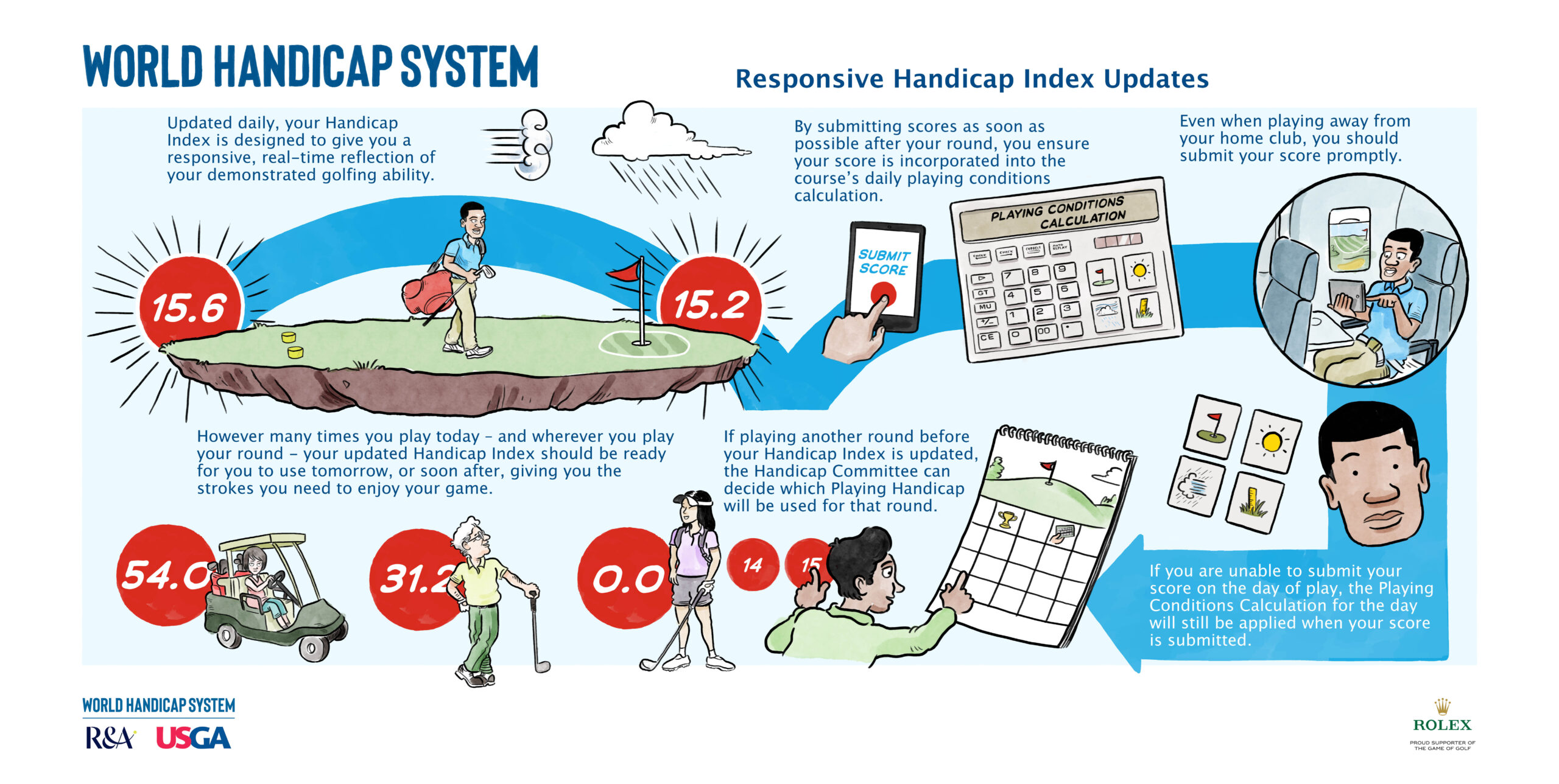
With the World Handicap System, the Handicap Index is computed and updated daily. This makes playing more fun and fair, as handicaps always include the latest scores. For new players, a Handicap Index is computed the day after they post the minimum 54 holes of play.
Daily revisions (and the Playing Conditions Calculation) make it imperative that players post their scores before midnight on the date played.
Handicap Calculation
Getting a Handicap Index is easy and very affordable, even if you’re a newer golfer. With a handicap you can:
- Track your progress over time.
- Play against golfers of different ability.
- Easily figure out your Course Handicap at different courses and from any tee box.
Once a full playing profile of 20 scores is reached, a player’s Handicap Index is calculated using the lowest eight of the most recent 20 scores.
Playing Conditions Calculation
The Course Rating System is the cornerstone of handicapping and measures the difficulty of a course under normal conditions. But a good score on a normal day may turn mediocre when the weather is challenging, and tough setups or seasonal conditions can have a significant impact.
The Playing Conditions Calculation (PCC) is triggered when abnormal conditions cause scores to be unusually high or low on a given day. It is an automated, conservative statistical procedure that requires at least eight scores submitted on the day of play. Players should post scores immediately after play so the PCC is applied when appropriate.
Exceptional Score Reduction
Exceptional Score Reduction (ESR) handles scores that may indicate a player’s true ability. If a player posts a score differential 7.0 strokes or better than their Handicap Index, an automatic adjustment is applied to up to 19 of their previous scores, lowering their Handicap Index. Multiple ESR adjustments are cumulative.
Course and Playing Handicap
Your Handicap Index computes to a Course Handicap at any course you play — find it before your round on the handicap computer or GHIN app. It varies with the course’s slope rating and the tees you play.
Your Playing Handicap is your Course Handicap adjusted for any handicap allowances or Terms of the Competition — for some events, players receive only a percentage (80%, 85%, etc.) of their Course Handicap.
Soft and Hard Caps
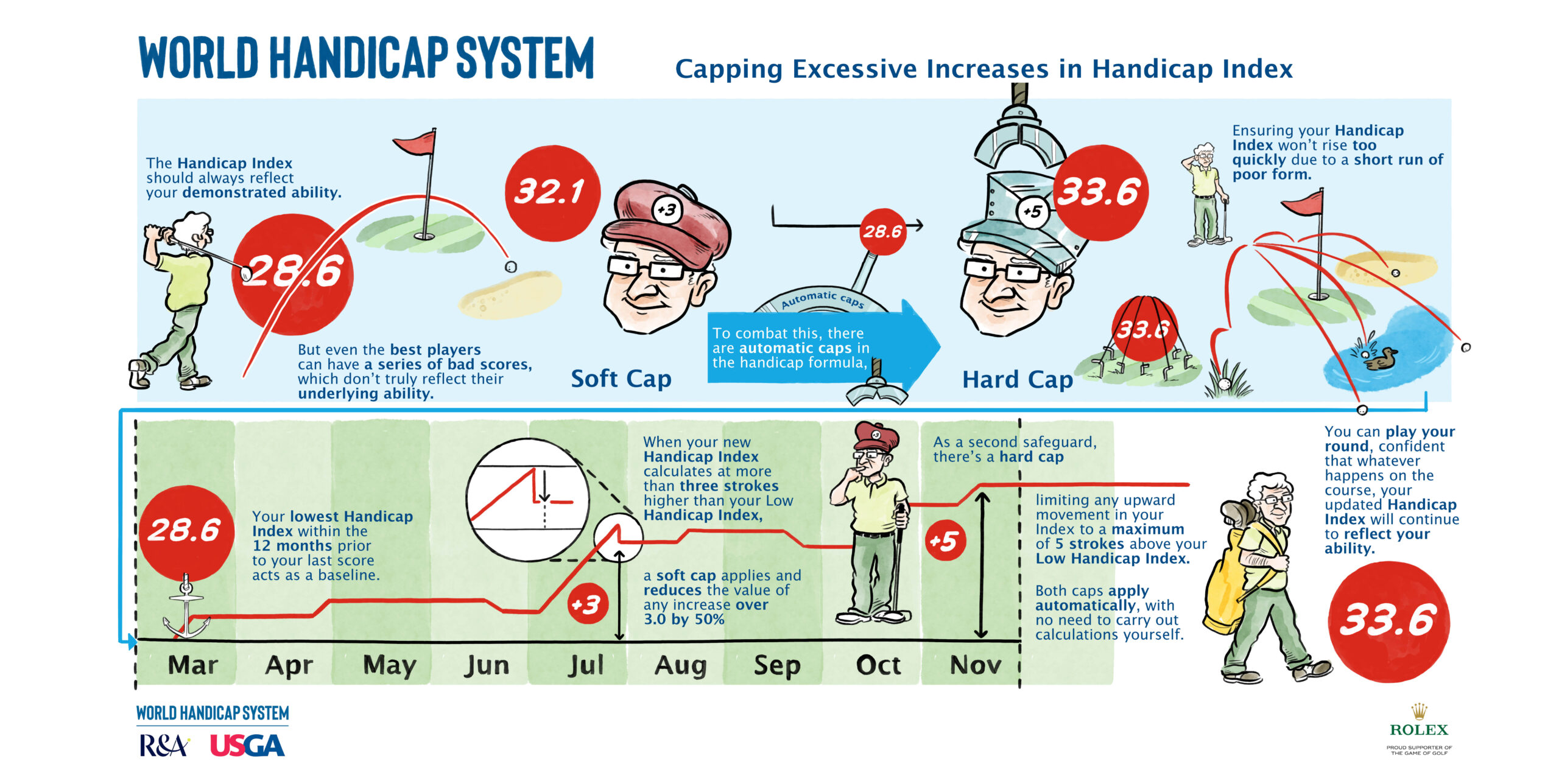
The WHS limits upward movement of a Handicap Index based on the player’s Low Handicap Index from the previous 12 months. The Soft Cap suppresses upward movement by 50% after a 3.0 increase; the Hard Cap restricts upward movement to 5.0.
Net Double Bogey
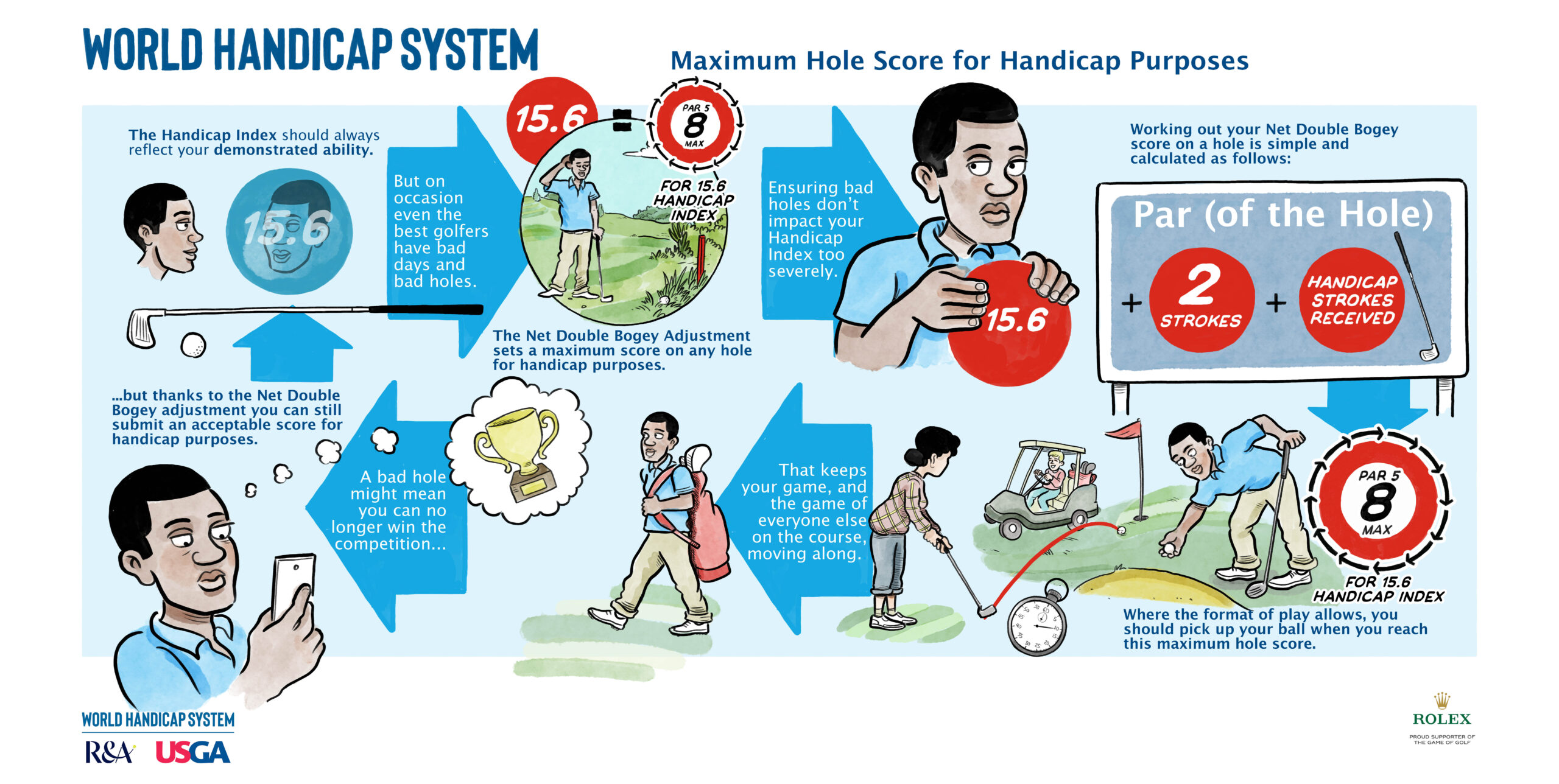
Net Double Bogey reduces the effect of a bad hole or two on your posted score. Think of it as “Double Bogey Plus”:
Par + 2 + any handicap strokes received on the hole
The best way to apply Net Double Bogey correctly is to post your score hole-by-hole on the GHIN app or clubhouse computer — the software adjusts affected holes automatically.
Most Likely Score is used whenever you start but don’t finish a hole: the strokes already taken plus the number it would take you to finish the hole most of the time.